> The full list of articles is in [llms.txt](https://docs.f3cloud.com/llms.txt). Every page has a Markdown version: add .md to its address. This page as Markdown: [https://docs.f3cloud.com/en/vpn-guide/openvpn-server-setup.md](https://docs.f3cloud.com/en/vpn-guide/openvpn-server-setup.md).
# Installing OpenVPN on a VPS with one command
How to set up your own OpenVPN server on a VPS with one command using the open-source openvpn-install script. Supported systems, installation, connecting on Windows, Android and iPhone, adding and revoking clients, removal and common errors.
**OpenVPN** is one of the best-known VPN protocols. It encrypts all traffic between your device and the server, and you go online from the server's IP address.
Installing OpenVPN by hand takes a long time, so we use the open-source [openvpn-install](https://github.com/Nyr/openvpn-install) script from GitHub. It installs OpenVPN, creates the certificates, sets up the network and gives you a ready file for connecting, all by itself. We checked every step on an F3 Cloud server with Debian 12.
> **The script does not work on every system.**
>
> The openvpn-install script needs Ubuntu 22.04 or newer, Debian 11 or newer, AlmaLinux, Rocky Linux or CentOS 9 and newer, or Fedora. On Ubuntu 20.04 and AlmaLinux 8 the script will refuse to run. In that case, first [reinstall the system](https://docs.f3cloud.com/en/client-area/reinstall-os.md) with a newer one.
You do not need a powerful plan. OpenVPN itself used less than 10 MB of memory on our server.
***
## Step 1. Install OpenVPN
Connect to the server [via SSH](https://docs.f3cloud.com/en/vps/termius-connection.md) as the root user and run the command.
```bash
cd /root && wget https://raw.githubusercontent.com/Nyr/openvpn-install/master/openvpn-install.sh -O openvpn-install.sh && bash openvpn-install.sh
```
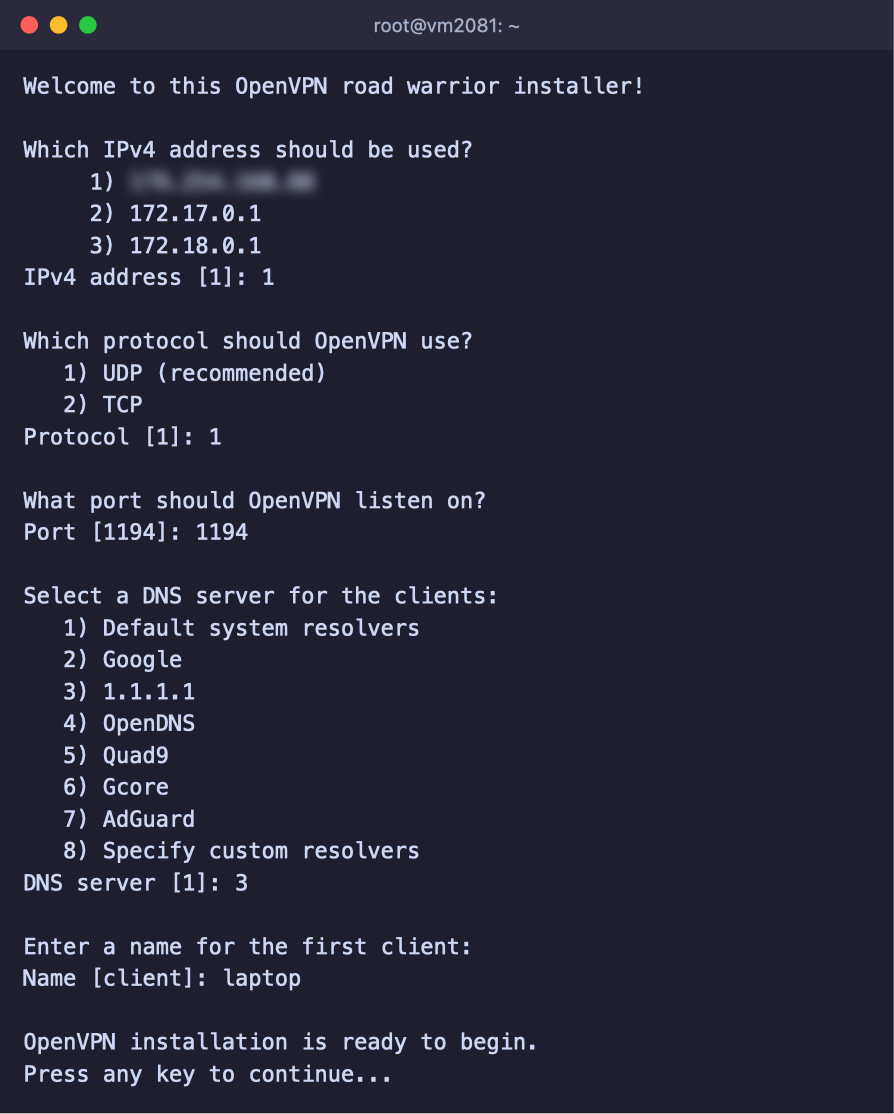
The script will ask a few questions. If you are not sure what to choose, just press Enter, because the default values will do.
1. **Which IPv4 address should be used?** – which IP address to use. This question only appears if the server has several addresses. Choose the public one, which is your server's IP from the client area.
2. **Protocol** – leave `1` (UDP), as it is faster. TCP is only needed if UDP does not work on your network.
3. **Port** – the server port, 1194 by default.
4. **DNS server** – which DNS servers your devices will get. `3` (1.1.1.1) or `2` (Google) will do.
5. **Name** – the name of the first client, for example `laptop`. The connection file is named after it.
Answers to the installer's questions
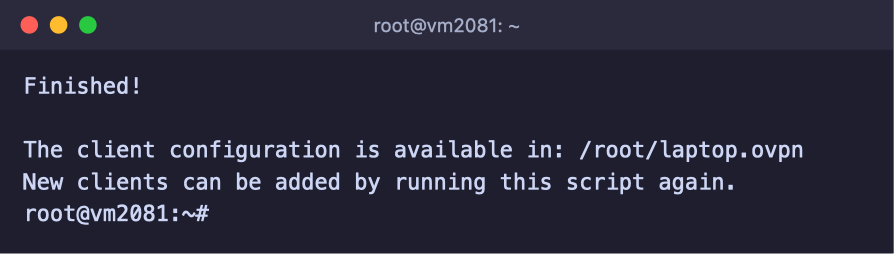
Use only Latin letters, digits, hyphens and underscores in the client name, because the script replaces any other characters with `_`. Then press any key, and the installation begins. It takes less than a minute.
OpenVPN is installed and the connection file is ready
The ready connection file is in the `/root` folder and is named after the client, in our example `/root/laptop.ovpn`. OpenVPN is already running and will start by itself after the server reboots.
***
## Step 2. Download the connection file
The `.ovpn` file needs to be moved from the server to the device you will connect from. The easiest way is the `scp` command on your own computer. Replace `SERVER-IP` with your server's address.
```bash
scp root@SERVER-IP:/root/laptop.ovpn .
```
The command saves the file to the current folder. macOS and Linux have it out of the box, and in Windows 10 and 11 it comes with the OpenSSH client and runs in PowerShell. If PowerShell does not recognise the command, turn on the **OpenSSH Client** component in the Windows optional features. If you prefer using the mouse, you can download the file over SFTP in [Termius or MobaXterm](https://docs.f3cloud.com/en/vps/best-ssh-clients.md).
> **The connection file is the key to your VPN.**
>
> Anyone who has your `.ovpn` file can connect to your server. Do not publish it or send it through public chats. Create a separate file for each person, as shown in step 4.
***
## Step 3. Connect to the VPN
To connect, you need the official **OpenVPN Connect** app.
#### Windows
1. Download OpenVPN Connect from the [official website](https://openvpn.net/client/) and install it.
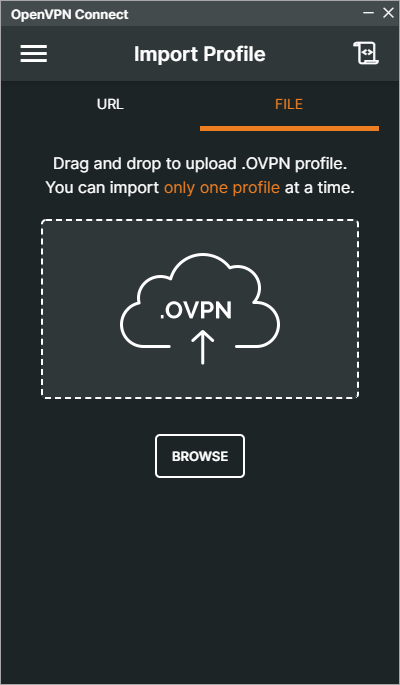
2. Open the app, go to the **FILE** tab and click BROWSE. Choose the downloaded `.ovpn` file.
Importing the connection file
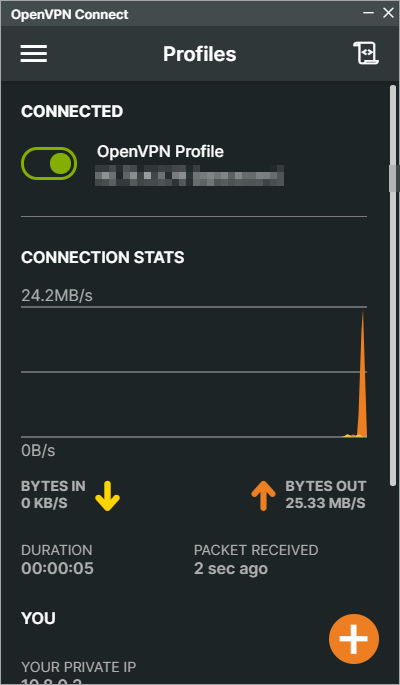
3. Turn on the switch next to the profile. When **CONNECTED** appears, the VPN is working.
The connection is established
#### Android and iPhone
1. Install OpenVPN Connect from [Google Play](https://play.google.com/store/apps/details?id=net.openvpn.openvpn) or the [App Store](https://apps.apple.com/app/openvpn-connect/id590379981).
2. Send the `.ovpn` file to your phone, for example to your Saved Messages in a messenger or by email, and open it with the OpenVPN Connect app.
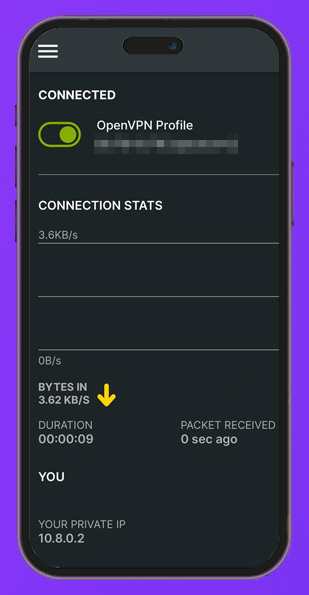
3. Turn on the switch next to the added profile. When **CONNECTED** appears, the VPN is working.
Connection on the phone
To make sure your traffic goes through the VPN, open [api.ipify.org](https://api.ipify.org) in your browser. It should show your server's IP address.
***
## Step 4. Add devices and people
One connection file can only be used on one device at a time. If you connect with the same file from a second device, the first one disconnects. That is why you should create a separate file for your phone, your laptop and each person.
Run the script again.
```bash
bash /root/openvpn-install.sh
```
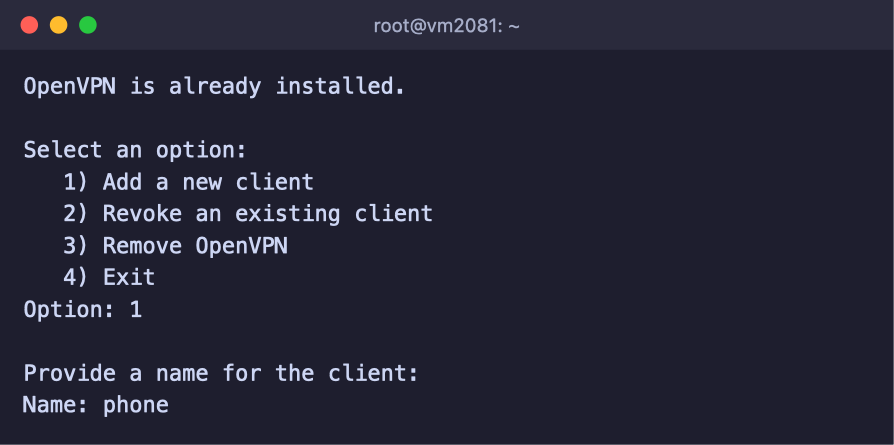
This time it shows a menu.
Adding the phone client
| Option | What it does |
| --- | --- |
| `1` Add a new client | Creates a new client and its `/root/name.ovpn` file |
| `2` Revoke an existing client | Revokes a client, and its file stops working at once |
| `3` Remove OpenVPN | Completely removes OpenVPN from the server |
| `4` Exit | Exits the script |
To add a client, choose `1` and enter a name, for example `phone`. At the end, the script shows where the new file is, for example `phone added. Configuration available in: /root/phone.ovpn`.
To close someone's access, choose `2`, enter the client's number in the list and confirm the revocation with `y`. The server stops accepting that client's file straight away, and the other clients keep working.
***
## Frequently asked questions
The app does not connect
First check that OpenVPN is running with the `systemctl status openvpn-server@server` command. The **Active** line should say `active (running)`. If the ufw firewall is enabled on the server, open the OpenVPN port in it with the `ufw allow 1194/udp` command. If you chose a different port or TCP, use those instead.
OpenVPN does not work on my network
Some networks block OpenVPN traffic. Try reinstalling OpenVPN with the TCP protocol. To do this, remove it with option `3` in the menu and run the installation again. If that does not help either, use protocols that are harder to block, for example [Amnezia](https://docs.f3cloud.com/en/vpn-guide/setup-amnezia.md) or [VLESS Reality in 3X-UI](https://docs.f3cloud.com/en/vpn-guide/3x-ui-panel-guide.md).
The script says “Ubuntu 22.04 or higher is required”
The system on the server is too old, and the script does not support it. [Reinstall the system](https://docs.f3cloud.com/en/client-area/reinstall-os.md) with Ubuntu 22.04 or 24.04 or Debian 12 and run the installation again.
The VPN disconnects on the second device
You are connecting with the same file from two devices. In this case the server keeps only the latest connection. Create a separate file for the second device with option `1` in the menu.
How to remove OpenVPN completely
Run `bash /root/openvpn-install.sh`, choose `3` and confirm with `y`. The script removes OpenVPN, its settings and its network rules. The `.ovpn` files in the `/root` folder stay, but they no longer work, and you can delete them by hand.
***
## Our resources
**Telegram channel:** [https://t.me/f3cloud_news](https://t.me/f3cloud_news)\
**F3 Cloud:** [https://f3cloud.com](https://f3cloud.com/en)